Running a cornhole night: from blind draw to PPR stats
A walk through one Friday blind draw in LiveCup: 26 names become 13 pairs, the bracket gets its byes, games are scored inning by inning on a phone and the stats go up on the bar screen.
It is 7:40 on a Friday at Ironwood Taproom. Sign-ups close at 8, there are four sets of boards on the patio, and 26 people have written their names on the clipboard by the door. Some came with a partner, most did not. This is how the organizer, Dana Ortiz, gets from that clipboard to a running bracket before the first bag is thrown, and what LiveCup does at each step.
Step 1: Turn a list of names into random pairs
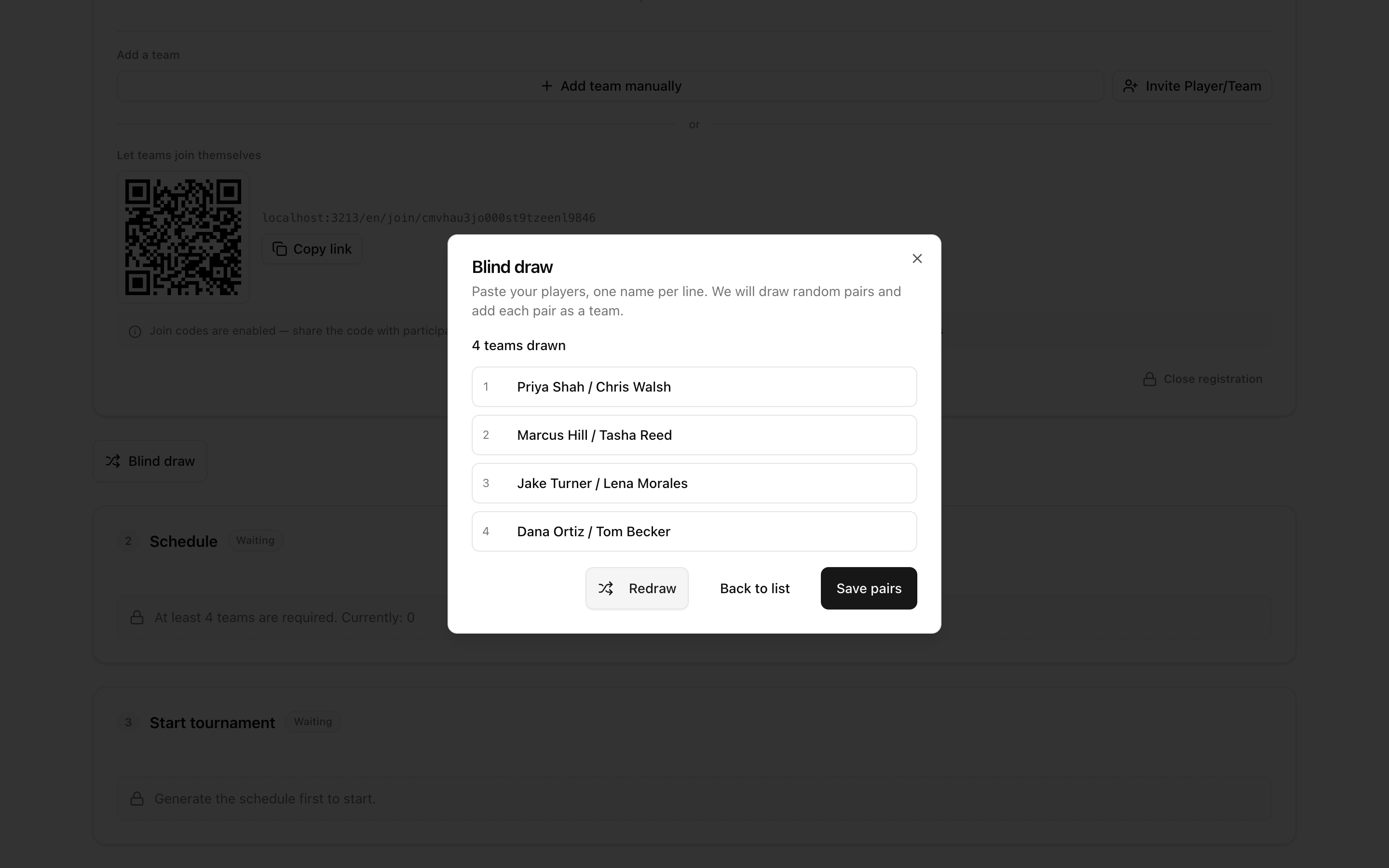
Dana creates a cornhole tournament and opens the blind draw. She pastes the 26 names from the clipboard, one per line, and LiveCup draws 13 random pairs. Each pair is named after its players, so the bracket shows "Marcus Hill / Tasha Reed" instead of "Team 7", and nobody has to invent a team name at the bar.
Her regulars throw a lot better than the people who came for the beer, so she turns on skill pools, puts the regulars in pool A and everyone else in pool B. Every pair then gets one player from each pool, which keeps the strongest throwers from teaming up. If the count is odd, she picks whether one player sits out or plays alone. And if the draw looks wrong, she draws again before saving.
The blind draw is free. If you take sign-ups in advance instead, the QR sign-up form on PRO can collect pairs with both names, and players who signed up alone can be paired with one button.
Step 2: A double elimination bracket that handles 13 pairs
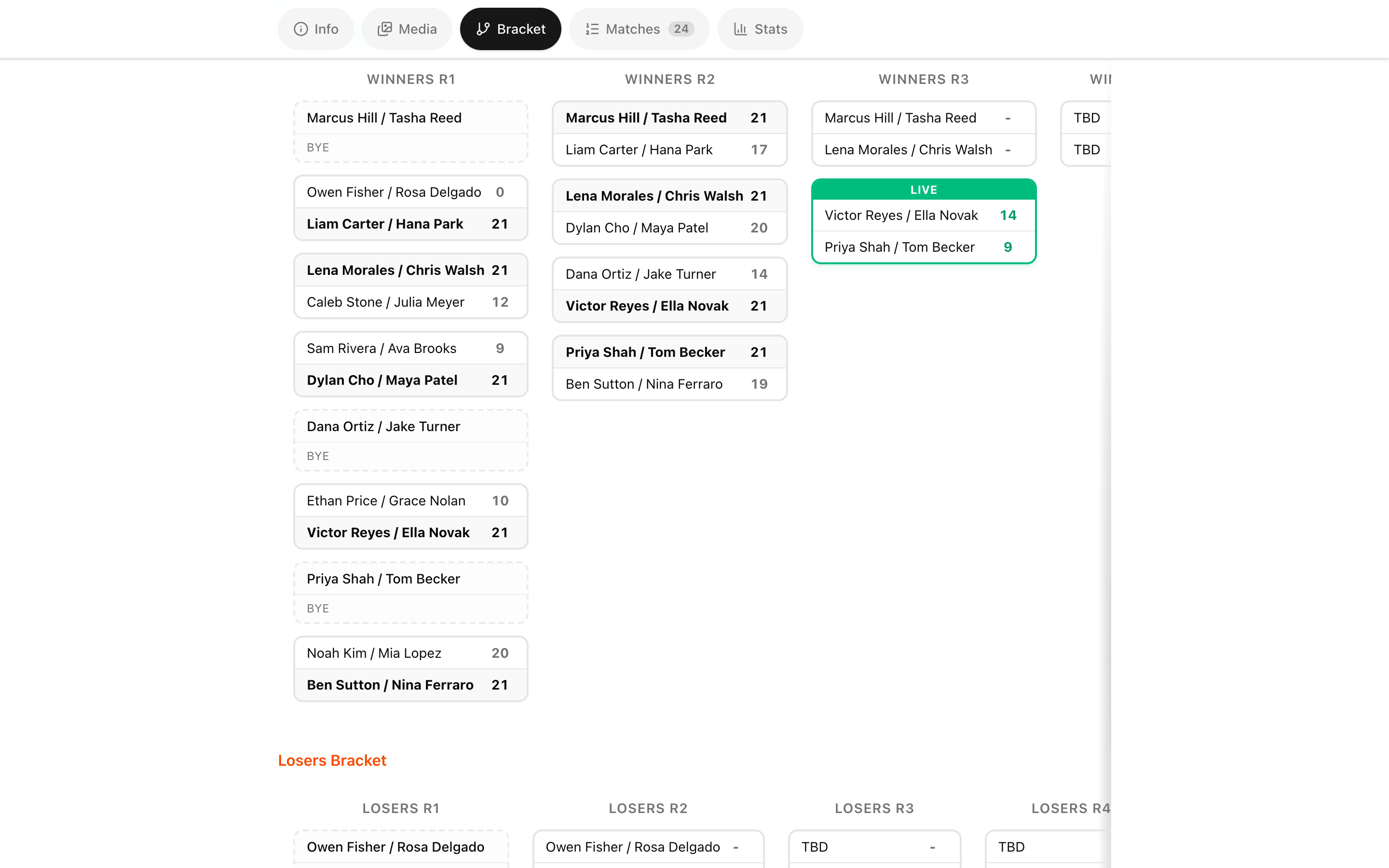
Thirteen is an awkward number for a bracket. The usual fix is to add three fake "Bye" teams by hand and hope they land in the right places. LiveCup now does it for you: in single and double elimination, the bracket is built for any team count, and the top seeds get the byes. With 13 pairs, seeds 1, 2 and 3 go straight to round two, and the rest of the bracket stays balanced.
Double elimination fits a bar night because nobody drives over to lose one game and go home. Lose once and you drop to the losers bracket, lose twice and you are out. The winners bracket, losers bracket and final stay in sync as Dana enters results.
On a bigger night she could start with pools instead. The pools to double elimination format puts everyone in a pool for a few games, then sends the top teams into a double elimination bracket, with byes when the number of qualifiers is odd.
Step 3: Set the target and get games onto the boards
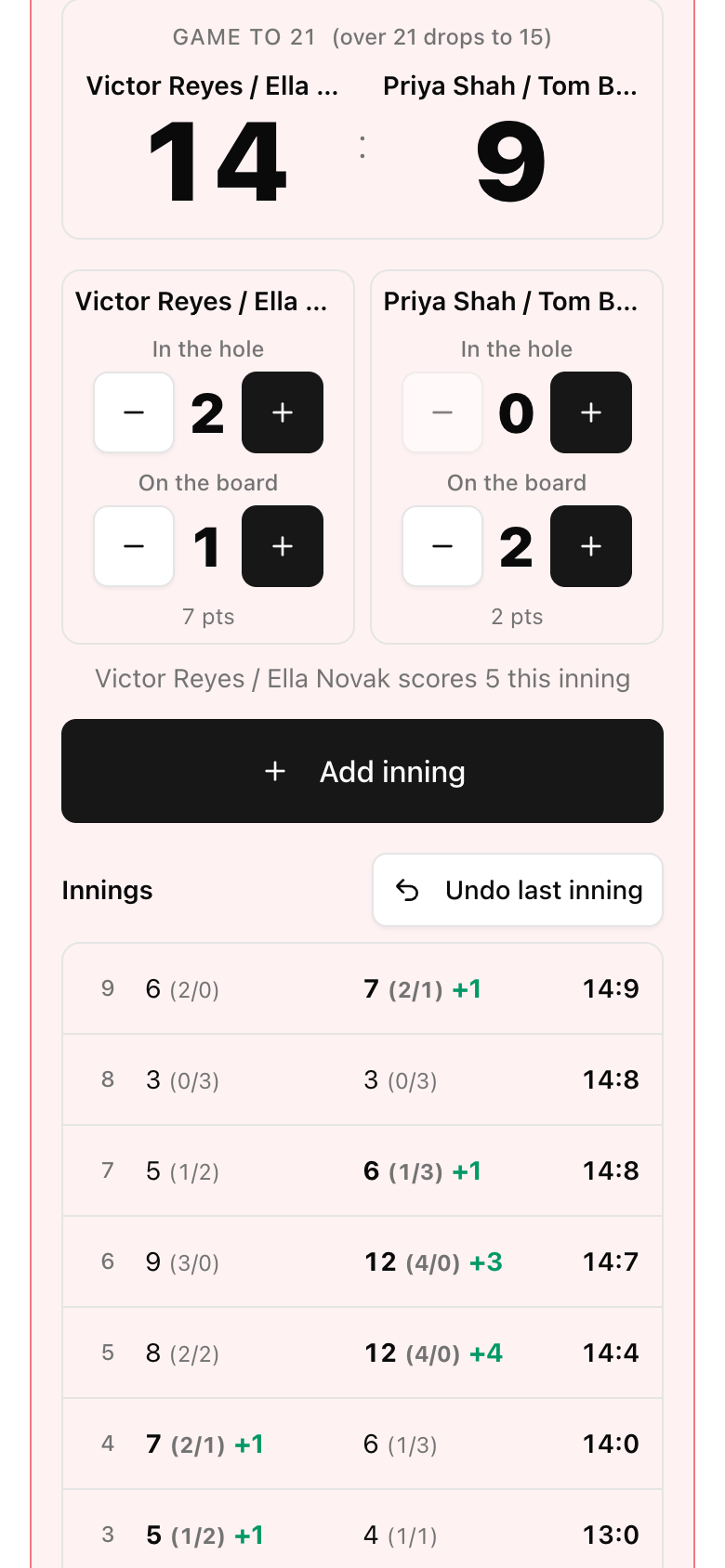
Dana sets the game to 21. You can also pick 11 or 15 for a shorter night, or leave it empty. The target shows on the match page and the TV, so players know what they are playing to without asking.
With PRO, she tells LiveCup she has four boards. Games are put on boards, and the next game is called to a board as soon as one is free. Everywhere in a cornhole tournament, the panel, the schedule and the TV, the wording is "board", not court or pitch.
For the early rounds, Dana does not care about the exact score, only who moves on. Quick winner records the result with one tap, saved as 1 to 0. It is free, and it is the fastest way to keep a big bracket moving. The trade-off is that a 1 to 0 result adds almost nothing to point differential.
Step 4: Score the bags, one inning at a time
From the quarterfinals on, Dana wants real numbers, so the tournament has inning scoring turned on. After each inning, the scorer enters how many bags each side put in the hole (3 points) and on the board (1 point). LiveCup works out cancellation scoring, so if Marcus Hill's side scores 7 and the other side scores 4, only the 3-point difference goes on the scoreboard.
Her league plays the bust rule: go over 21 and you drop back to 15. It is optional, and the drop-back number is yours to set. If someone taps the wrong number, the last inning can be undone, and earlier innings can be edited.
The scorer does not have to be Dana. Innings can be entered from the match page, from the referee view by a volunteer she invites, or by the players themselves from their own link. Referees and player links need PRO. However the game is scored, the final score goes to the bracket, the table and the TV exactly as if she had typed it in.
Step 5: PPR, DPR and four-baggers on the screen
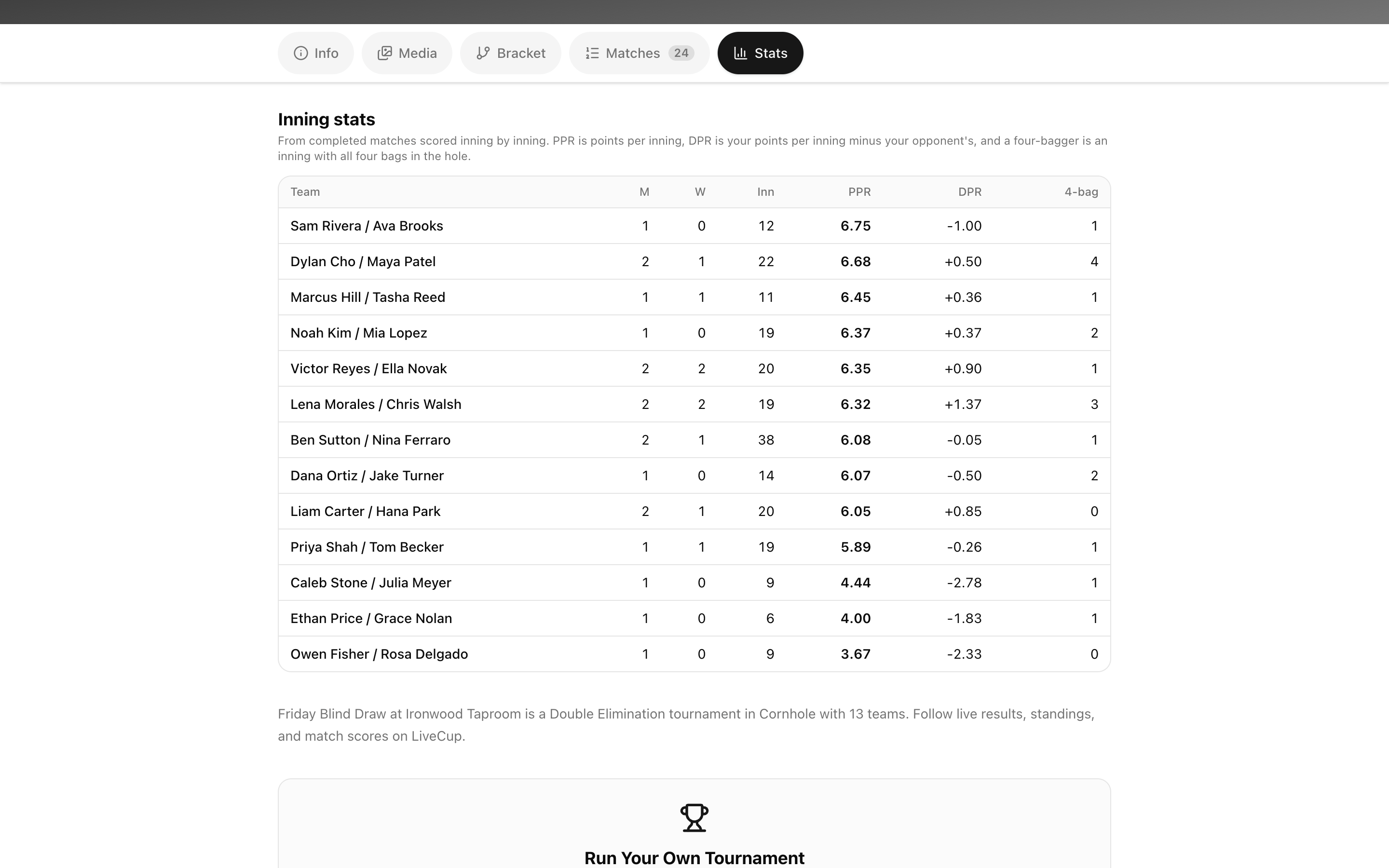
Every scored inning feeds the stats. PPR (points per round) is how many points a team puts up per inning before cancellation. DPR (differential per round) is how much it outscores the other side per inning, which says more about who is winning the board. Four-baggers count the innings where all four bags went in the hole.
The stats appear on each public match page and in a Stats tab, both in the operator panel and on the public tournament page. Dana opens the public Stats tab on the second screen by the bar, so people waiting for their next game check who has the best PPR instead of asking her. The main TV keeps showing the bracket.
Other ways to run the night
Not every cornhole night needs a bracket. In a rotating-partner Americano, people sign up as individuals and get a new partner every round. Games are played to the target score with no points cap, or in timed rounds, and the standings rank players by wins, then point difference, then points scored. It is free. Inning scoring is not used in Americano, so you enter the final score of each game.
Weekly leagues use round robin, where everyone plays everyone. Past 10 teams that gets long fast: 16 teams means 120 games. LiveCup shows a hint at that point and suggests pools and a bracket instead.
What is free and what is paid
Free: the blind draw, automatic byes, the target score and quick winner, pools to double elimination, rotating-partner Americano and public match pages. The free plan covers tournaments with up to 4 teams, which is enough to try the whole flow.
A night like Dana's, with 13 pairs, needs more than 4 teams. A one-time Event Pass unlocks that one tournament for up to 32 teams. Boards with autopilot, pair sign-up, referees and player score links need a PRO plan, which also gives you 32 teams in every tournament.
Cornhole tournament night FAQ
How do you run a blind draw cornhole tournament?
Collect the names of everyone who wants to play, paste them into the blind draw in LiveCup and it draws random pairs. Optionally split the players into A and B pools first, so each pair gets one of each. Then build a bracket from the drawn pairs, usually double elimination.
What happens with an odd number of players in a blind draw?
You choose. One player can sit out, or one player can play alone. With an odd number of pairs, the bracket adds byes for the top seeds, so you do not need a fake team either.
How many byes does a cornhole bracket need?
Enough to fill the bracket up to the next power of two. 13 pairs need 3 byes to make 16, 20 pairs need 12 byes to make 32. LiveCup adds them automatically in single and double elimination and gives them to the top seeds.
What is PPR in cornhole?
PPR means points per round: the points a team scores in an inning before cancellation, averaged over the game. A bag in the hole is 3 and a bag on the board is 1, so a four-bagger is a 12-point inning. DPR, differential per round, is the average amount by which a team outscores the other side per inning.
What is the bust rule in cornhole?
In leagues that play it, a team that goes over the target score drops back to a lower score, usually 15. In LiveCup the bust rule is optional, works with inning scoring, and you set the drop-back score yourself.
Do I have to score every inning?
No. Inning scoring is off by default. You can enter the final score, or tap the winner if the score does not matter. Inning scoring is for organizers who want the bust rule and PPR stats, and it is free on every plan.
Is the blind draw free?
Yes. The blind draw, A and B skill pools, automatic byes and quick winner are all free. The free plan covers up to 4 teams, and a bigger tournament needs an Event Pass or a PRO plan.
Related Articles
Byes in the Playoffs
Your knockout stage no longer has to be 4, 8 or 16 teams. When the number that advances from your groups isn't a power of two, LiveCup balances the bracket with first-round byes — and you decide who gets them.
Double Elimination Tournament: Complete Guide & Bracket Generator
How winners brackets, losers brackets, and grand finals work – plus a free tool to generate your bracket in seconds
Let players score their own matches. The next match finds a free court by itself.
Personal scoring links with QR codes, optional opponent confirmation, and an autopilot that puts the next ready match on the next free court or board.
A Scoreboard You Can Read From the Back of the Hall
Bigger type, stronger contrast, digits that never jump — plus your own colours and typeface on PRO.
Run your next cornhole night on LiveCup
Paste the names, draw the pairs and have the bracket on the TV before the first bag is thrown.
Create a cornhole tournament